Pages

Thursday, March 21, 2019

A Small Valley


"We're off to find Filmy Ferns." I've said that before and we failed to do so, but I was more sure this time as I has a reliable report from an NRW field worker. The only question was whether we would make it to their sites - in a narrow gorge on the edge of Abergwesyn Commons.

We did make it and found the Filmy ferns lower down in the gorge than we might have had to go (to the previous reported site). It made a great expedition for us and we were delighted by the gorge itself and the various plants we found there.

Before we had gone very far there were trees (and ground evidence) to discuss. Joan was sure that the evidence from the litter was unequivocal for Sweet Chestnut but we couldn't spot the tree. Eventually (on the way back) we found very definite and unmistakeable fruits confirming this species' presence. Joan had stuck to her guns and was right. We also found Beech on the way back and the correct fruits for that. I have to say the Sweet Chestnut debris represented a tree far from its comfort zone and were very poorly developed!

There were great displays of Polypody on the trees as we set out:
Intermediate Polypody, Llawredynen ganolig or Polypodium interjectum


The steep sides of the gorge up ahead in the mist.
Exploring the lower reaches.
There were lovely cascades of this:
Opposite-leaved Golden-saxifrage, Eglyn cyferbynddail or Chrysosplenium oppositifolium

The first cluster of the target ferns we found.
Wilson's Filmy-fern, Rhedynach teneuwe Wilson or Hymenophyllum wilsonii
This picture from a later site shows the well-developed indusia containing sporangia that hold the spores.
Sue at one of the sites.

More pictures (25/3/19 - Thanks Sue)


.....................................

Monday, March 18, 2019

A Quick Look at the Wye

A quick trip yesterday to the Wye at the Warren near Hay to see if Moschatel (Town-Hall Clock) was yet findable there.

The river was higher than I have seen it after this week's rain but we are lucky here that the river still has quite extensive areas to expand into upstream without serious problems usually occurring.

I found the Moschatel at two sites - one of them nearly underwater on the bank:
Moschatel, Mwsglys or Adoxa moschatellina
(The nearly drowned example.)

Other good things to see as well - spring has arrived in Hay...
Primrose, Briallen or Primula vulgaris

Sweet Violet, Fioled bêr or Viola odorata

Early Dog-violet, Fioled y coed or Viola reichenbachiana

All phone pics so not usual standard...


Friday, March 15, 2019

A walk around Sennybridge

Probably our best find on a windy but pleasant day was this growing in a steep hedge bank in quite some abundance near Sennybridge.
Picture: Arlene Jones
Black Spleenwort, Duegredynen goesddu or Asplenium adiantum-nigrum

It was a good location to select in the conditions with most places we went being quite sheltered.

We found a patch of Butterbur by the Usk - flowering already in a location that would have been under water the previous day (I was there and saw the level).
Butterbur, Alan mawr or Petasites hybridus

It's an interesting species that apparently really was used to wrap butter in the past (they grow to be huge). But there are doubts about its status as a native. "Perhaps native only where both sexes occur" (as it says in Stace). But then the means of distribution - even if vegetative via lorry tires - surely isn't significant? (The plants we have are all male.)

Always a pleasure to see:
Opposite-leaved Golden-saxifrage Eglyn cyferbynddail or Chrysosplenium oppositifolium

As is this:
Moschatel, Mwsglys or Adoxa moschatellina 

An old pack-horse bridge, widened in 2002.

And me looking for Anemones.
Picture: Arlene Jones

Sunday, March 10, 2019

Near the Wye

These venerable oaks were probably the highlight of our rather wet Wye-side walk last week. Ray, who was with us, explained that he had tried to research the history of them some time ago with little success.
Even the coppicing of them seems to have  had an unusual history judging from the present trunk profile.

The north-eastern aspect with moss and lichen etc. Nothing rare though.

This bridge over the long-defunct Mid-Wales Railway line provided some extra records:
- with quite a lot of Maidenhair Spleenwort and one solitary Rustyback fern. Spearwort in the water below.

Meanwhile Steph has visited some translocated wild Daffodils:
Daffodil, Lent Lily, Cenhinen-Bedr wyllt or Narcissus pseudonarcissus

and a Snowdrop I collected from a verge in the south west of the county some time ago revealed itself:
Green Snowdrop, Eirlys Icaria or Galanthus woronowii
What we encountered in late March 2017 - not the usual Snowdrop leaf colour.

Tuesday, February 26, 2019

Still rather early

But a great day out and we recorded some significant species.

The views were good as well:
Corn du, Pen y Fan and Cribyn from Ponsticill

At least one Celandine was out in full display:
Lesser Celandine, Llygad Ebrill or Ficaria verna

Admiring a venerable Hawthorn

Magnificent displays of catkins

Joan discovers an Ash tree with a big problem

And some extensive limestone pavement under old Crab Apples and Field Maple:

In haste...

Thursday, February 07, 2019

Stanner and Mistletoe

We visited Stanner Rocks yesterday to be guided around the reserve by Andy, the Warden, and shown the elusive "Radnor Lily".

This plant was only discovered in 1965 at the site and misidentified initially as Snowdon Lily (Gagea serotina). It was nearly ten years later that Ray Woods realised it was a previously unknown in the UK European species, Gagea bohemica, Early Star-of-Bethlehem or Seren-Fethlehem gynnar. At the time this was a different genus from the original name - but recently the Snowdon Lily has been reassigned as a Gagea, being Lloydia serotina in the 20th century.

There were two known flowering sites this year at the time we started - the plant is scattered all over the rock outcrops of Stanner and there are many thousands of them - but only a few plants flower each year. The plant dies back to invisibility by April, explaining why fair-weather past botanists didn't discover it.

Here are some of us photographing the two flowers at the first site:

Barbara here took a much better picture than mine from my phone below;

Here is a good patch of non-flowering plants up on one of the rock outcrops:

Andy then showed us around the site including the second flowering site of the plant and this pool which supports a wide range of rare mosses and liverworts around its edge.

Andy also showed us an example of the rare smut fungus he discovered growing on the Gagea leaves at the site. (It also occasionally is found on the more common Gagea lutea in other parts of the UK.)
Vankya ornithogali on Gagea bohemica leaf at Stanner Rocks

Vankya ornithogali is a plant pathogen, also called Yellow Star-of-Bethlehem Smut.

And the up on the crags we found another flowering Gagea bohemica.


The views from the higher crags are superb:

---------------------------------------------------------------------------------

Last week I took a break from desk work to chase up a species not recently recorded for a particular 10km square near home - Mistletoe. This establishes that the plant is present on this Lime tree and there will be a dot on the 2020 Atlas update map. I did find another tree but just outside the square boundary. A lot of the target square is taken up by the Black mountains - but Mistletoe remains a possibility on the lower slopes there as well. 
Mistletoe, Uchelwydd or Viscum album near Fforddlas

There are not many species in botanical recording that you can search for at this time of year in a car - but this is one!

Friday, January 18, 2019

Making a good start to the year

Choosing the right day for a botanical outing is the number one requirement in January and we managed that. It was cold but dry and sunny - ideal.

The outing was inspired by BIS (Biodiversity Information Service for Powys and the Brecon Beacons National Park) who regularly invite us and others to record a 1km square which, as yet, has no records at all. The square for January happened to be in a area we must focus on for botanical records this year so it was a good excuse for an early survey. But, in the spirit of the request, we also put our heads together to record as many of the non-plant living things that we could, adding a further 26 assorted species to our botanical list of over 100 records.

(These included: Reindeer Lichen, Blushing Bracket, King Arthur's Cake Fungus, Common Mole, Tamarisk Moss and we assume Yellow Meadow Ants deep inside the anthills we sat on for our lunch. Birds ably identified by Alan as the rest of us scrabbled in the mud were:  Buzzard, Raven, Crow, Chaffinch, Red Kite, Stonechat, Starling, Blackbird and Mistle Thrush.)


The lunch spot

The view towards Mynydd Troed and Castel Dinas (with The Dragon's Back just in the far right)

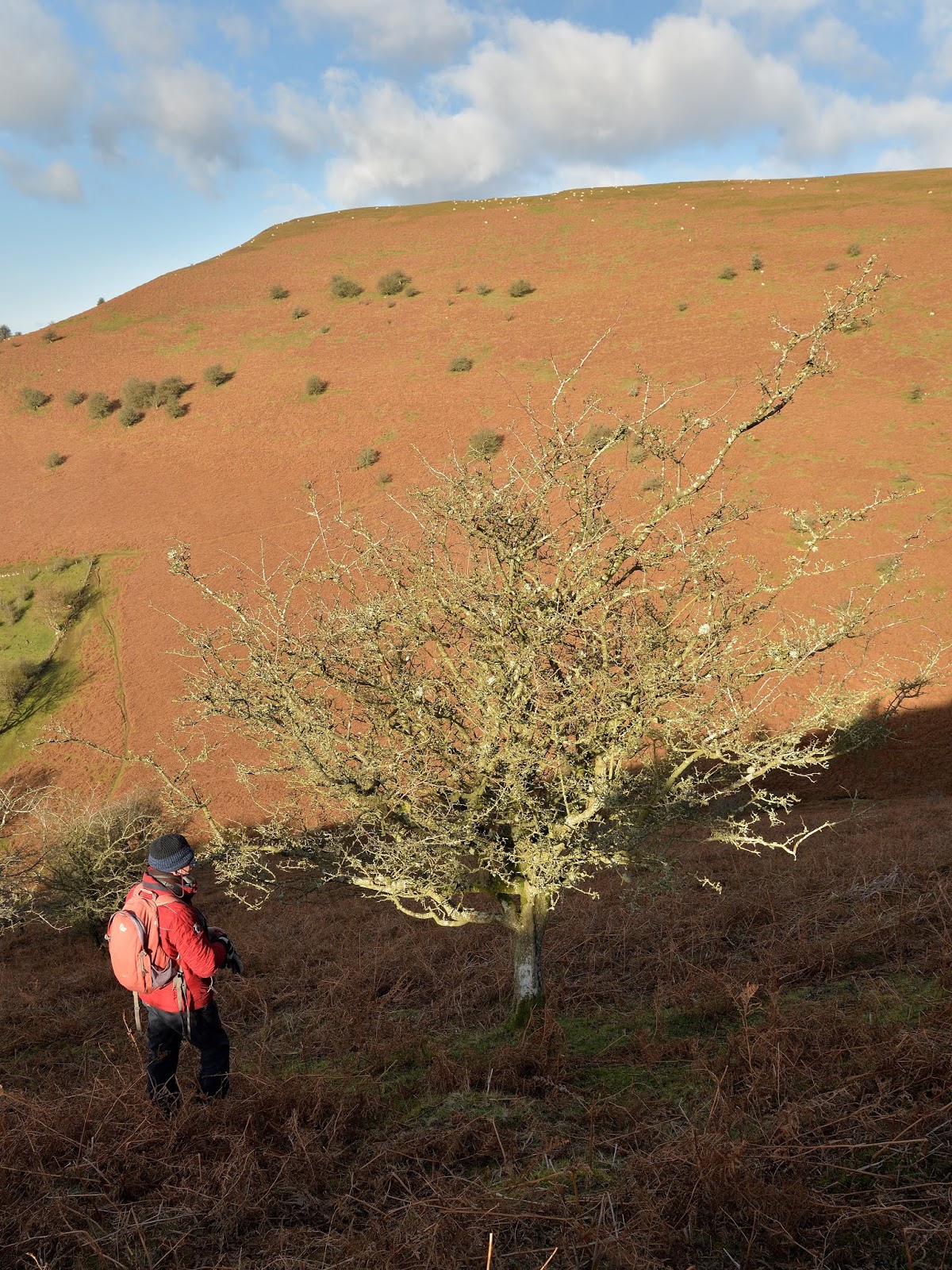
One of the many Hawthorns some of which, like this one, were encrusted with several lichens
Hypogymnia tubulosa

Usnea spp. (a Beard Lichen)

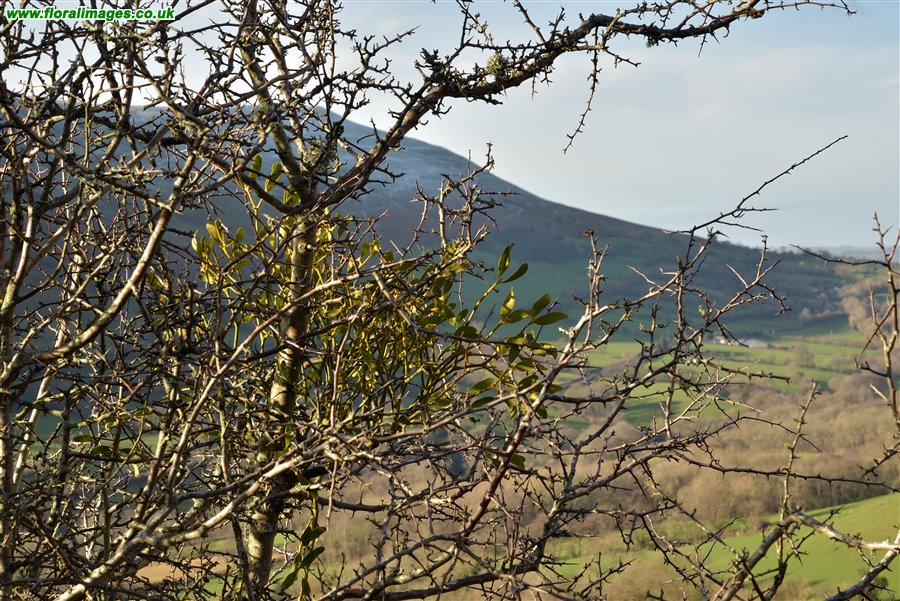
Mistletoe, Uchelwydd or Viscum album on one of the Hawthorns

And, on the way back to the car, the moon was rising over the ridge between Mynnyd Llysiau and Pen Twyn Glas

Thursday, January 03, 2019

BSBI New Year Plant Hunt number five

We went out on our 5th New Year Plant Hunt last Saturday - technically, according to the calendar, in 2018 - but this was the hunt for 2019 as now defined by the BSBI.

I may as well admit that it was our joint worst performance so far but, as always, it was rewarding and provided useful records beyond the tally of those plants actually managing to flower in the rather adverse conditions.

We saw an awful lot of dandelions before we found the one plant just opening its flowers and this was the general case for most common species. Not a single Hazel in the chosen area was shedding pollen (a requirement to count as "flowering") - but, of course, I saw some fully mature catkins on the way back into Hay by the roadside...

But I choose our areas partly because they are places we need to make more records in and we got to know this under-recorded area well, finding a pretty certain Vicia tetrasperma plant right by Pontsticill dam which will make a first record for the area since 2000.


I photographed this from the dam wall base to examine further in the pub at lunch:
Cat's-ear Melynydd or Hypochaeris radicata

We also saw an undoubtedly planted Berberis darwinii or Darwin's Barberry in the reservoir car park - with one flower (which helped identification).


I have a video including the sound even a small amount of overflow creates here:

Bell-mouth Spillway video

Our previous hunts:

Builth 2015 (19 flowering)
Llangorse 2016 (19 again)
Ystradgynlais 2017 (18)
Crickhowell 2018 (53 - we will probably never surpass this!)
Pontsticill 2019 (well last days of 2018 really!) - this blog (18)

There have been eight altogether since the event started and "we" have participated in five. (Myself in four.)