Pages

Thursday, July 18, 2024

Finding rare plants

(Rare for our county that is.)

I have been away for much of the time since the last post but that didn't stop the intrepid Brecknock Botany Group members going out and finding things.

Some notable finds:

Chrysosplenium alternifolium (Alternate-leaved Golden-saxifrage)
Lathraea squamaria (Toothwort)
and Wahlenbergia hederacea (Ivy-leaved Bellflower) all near Erwood by Anne Griffiths

Lathyrus nissolia (Grass Vetchling) in Brecon by Joan Millard

Sherardia arvensis (Field Madder) Field edge near Newbridge by Fiona Stone.

Since I came back the main event has been the full confirmation of Circaea alpina at a completely new site on Tarren yr Esgob, right on our border. Sam Thomas took us to it, confirming the difficulty of access and that the population was more extensive and robust than first thought. It is near one of the well-recorded Sorbus stenophylla trees but far enough above on difficult terrain to easily be overlooked. As when Sam first found the site, it poured with rain!

Alpine Enchanter's-nightshade or Llysiau-Steffan y mynydd, Circaea alpina
Picture by Steph Coates

At our BSBI meeting on 13th July we found several long unseen species at Craig y Rhiwarth, particularly Galium sterneri (Limestone Bedstraw), Convallaria majalis (Lily-of-the-valley) and Polypodium cambricum (Welsh Polypody).

Limestone Bedstraw or Briwydd y calch Galium sterneri
Picture by Tim Oliver


Sunday, June 02, 2024

Mid Year Catch Up

We have encountered Buck's-horn Plantain twice in the last few weeks, which rather contradicts the Stace distribution information: "mostly near sea ... inland in scattered lowland places mainly in England".

The first was at 260m near the Caban Coch Dam above the Elan Valley Centre.

Buck's-horn Plantain or Llyriad corn carw (Plantago coronopus) at Caban Coch

The next encounter was along the road across Llangynidr / Llangattock Mountains at nearly if not quite 500m.
As above - this time found by Anne and Joan

But note how hairy this one is. Stace is helpful here: "Variably hairy annual to perennial ...". We love and depend on Stace's "New Flora of the British Isles" - Fourth Edition and the remarks above should be taken in the spirit of a quest to update the knowledge for further editions...

The plant is now known along at least a mile - probably more - of that mountain road.

I spotted the next find when taking a short walk in Talgarth, there on the Ennig was a familiar Willow, or was it ? The look and feel was Bay Willow which we started getting to know at its few sites in the county last year. But this one has longer leaves than the descriptions and keys allow. The answer was in the book - it must be the hybrid with Crack Willow:

Shiny-leaved Willow (Salix x meyeriana or Salix pentandra x fragilis)

Confirmation was impeded by it being inaccessible for samples (that is a long telephoto picture) but on a later visit I found more of it downstream in an accessible place.

Also in Talgarth was this:

Dewberry or Mwyaren Fair (Rubus caesius)

One of the few members of the genus that ordinary mortals can name with some confidence. There is plenty of it about in Hay also.


It was nice to see this through the fence in an adjoining field at Craig y Nos on a quick visit:

Marsh-marigold or Gold y gors (Caltha palustris)

A new record for the 1km square with only one record in 1998 anywhere near.


And this (grown from seed last year) flowered:
Carline Thistle or Ysgallen Siarl (Carlina vulgaris)

Not that common and a shy flowerer. It only opens up fully in full sun and sulks when clouds come over...

Saturday, April 13, 2024

Pillwort to Nonea

 We continue to have a botanically eventful start to the year.

Just after the last post several of us met up near Twyn y Beddau under Hay Bluff. I expected to easily show the group the Pillwort that grows up there but that wasn't how it turned out as the pools were very full due to recent rain and not a sign to be seen in most of them of the rare little fern in the water or at the edges. But we did find it at the last pool we looked in which had been thoroughly trampled by horses or cattle, churning up some floating examples:

Pillwort, Pelenllys gronynnog or Pilularia globulifera

(We did put this back!) Pictures from previous years:


Showing the characteristic unfolding of a small frond.

Then the following week at Capel y ffin we saw an abundance of Moschatel which we had been looking for and also happened on this patch of "ALGS" by the road:

Alternate-leaved Golden-saxifrage, Eglyn bob yn eilddail or Chrysosplenium alternifolium

The ALGS is to the right (about 3/4 of the frame) with the much more common OLGS (Opposite-leaved Golden-saxifrage) to the left. I only noticed the change in background texture when I viewed the photograph later. The basal leaves are quite different for the two species.

On the first trip up from Hay, my passenger, Anne, noticed "Alexanders!" on the way back. So I had to look for myself the next time - it's a narrow bit of the road so the drivers eyes have to be on the road ahead but we did spot it again, unfortunately with a car on our tail so couldn't stop. (If you know the road you will understand.) We managed a short stop for a photo on the way back that time.

Alexanders, Dulys or Smyrnium olusatrum

Not at all common in the county - our third record ever. It is more common in coastal areas and is thought to be a Roman introduction - their version of Celery - but quickly dropped when modern Celery was developed.

And today I heard of this, not 100m from where I live, from a group member who was in Hay yesterday:

Yellow Nonea or Nonea lutea

Growing at the edge of a pavement and spotted by Joan. New for the County but almost certainly a garden escape.


Friday, March 22, 2024

Some early botany

Several of us visited the Hutchinsia at Craig y Cilau on Wednesday. I like this picture because the Rue-leaved Saxifrage nearby, a small plant itself, gives a sense of the tininess of the Hutchinsia on the right.

Hornungia petraea, Hutchinsia, Beryn y graig.

Why Hutchinsia? - see this: Ellen Hutchins

The other main delight (apart from the spectacular views of course) was an abundance of rosettes of Early-purple Orchid - definitely to be visited again soon.

The team are out recording again with, for instance, four monad 20 year updates for Moschatel (or better - one monad was new).

See our current challenges here.

Tess has found Tuberous Comfrey straying from a garden into the wild for only the third county record.

Symphytum tuberosum, Tuberous Comfrey, Cyfardwf Oddfynog (Tess Lister)


And I took a new photo of the White Comfrey on a Llangattock verge, spotted by Ray Woods a few years back.

Symphytum orientale, White Comfrey, Cyfardwf wen


Saturday, October 14, 2023

Small-flowered Catchfly

 Not recorded since 1950 but seen last week by Ray Woods at the edges of a Swede field.

Small-flowered Catchfly, Gludlys amryliw, Silene gallica

So the history in the county goes: “Pen y lan, near Brecon” by Miss Bird in 1809, J A Wade (NMW), no date given but between 1930 and 1950 and now this. The species is in decline in the country - as an arable weed but this finding suggests there may be a long-lived seed bank.


Sunday, October 01, 2023

The Molinia Horribleness scale

 No exciting finds this week for the group (but a member, Anne found a Musk Thistle on the Usk):

Carduus nutans, Musk Thistle

The main group outing though always looked like a rather dim hope of great finds but at least we got some records for an unrecorded tetrad.

The outward walk was very hard going in boggy tussocky Molinia caerulea, Purple Moor-grass which I decided was at least an 8 on the Molinia horribleness scale* which I had just thought up.

And no rewards of any note for peering into the boggier bits with only a few records on the whole outward journey. We got far enough to see more promising land a further kilometre away but decided we had to turn back. 

We did agree to do a different route which we thought, from our observations coming along, might not be so bad - and it wasn't (7 maybe). Crucially though we did on that route find some "better" plants. (Apologies to Soft-rush, Foxglove and Heath Bedstraw - we do appreciate you really!)

Marsh Pennywort and Lady's Smock among other rather "better" finds.

The view from as far as we got.


* It goes up to 11...


Sunday, September 17, 2023

Quillwort at Llyn Carw


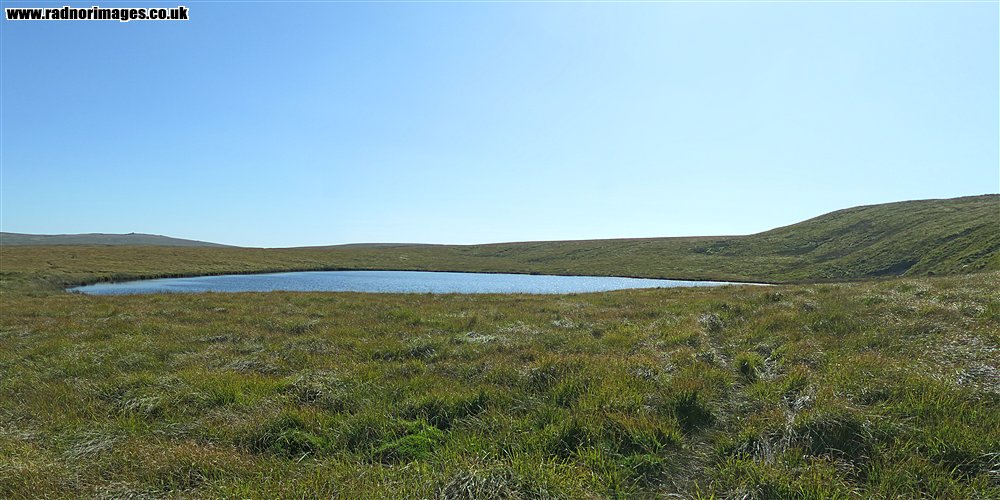
Llyn Carw - about 6 km trek across difficult moorland from Dolymynach.

The Cambrian Mountain Society teamed up their walking expertise with botanists last week on this walk to our most remote lake. 

Quillwort was found there in 1979 by Ray Woods and determined to be the rather more rare Spring Quillwort, Isoetes echinspora by S G Harrison at the National Museum of Wales. (He was a co-author of the book that describes them for Wales.)

It was at that time “Common on north and west margins”.

Gill Foulkes, a botanist member of the recent expedition, did find a Quillwort on the other side of the lake. (None was found where the original sample was taken.)

Here it is:
The Quillwort found by Gill Foulkes last week, which turned out to be Isoetes lacustris

You have to sacrifice a leaf to prove it's a Quillwort:

And knowing which one needs these megaspores to be examined:
They are about 0.5 mm across...

So maybe the lake does actually still have both of these Quillwort species (the north and west has the more suitable habitat for Spring Quillwort).

Further expeditions are required!

And the members of this walk did prove that botany and long walks can be compatible - with a good recce prior to the day...


Friday, September 01, 2023

An exciting find and other matters

 A record popped up on iRecord last week that is a great new find for the Vice County.

We already have the most southerly occurrence of Circaea alpina (Alpine Enchanter's Nightshade) in the British Isles I think but our one small (and somewhat struggling) population at Craig y Cilau is now joined by a substantial and healthy population found by Sam Thomas while visiting the (also very rare) population of Sorbus stenophylla near Capel y Ffin in the Llanthony valley.

Circaea alpina (Alpine Enchanter's Nightshade) picture, Sam Thomas

Sam said "The rain was torrential and we started from the top which was an unwise choice, once we'd seen the Sorbus we decided to cut straight down the cliff to escape the rain as quickly as possible. We found the Circaea on the way down. It was in a very inaccessible location so not that surprising that it hadn't been found before."

There are a good number of plants on at least two levels of a small, mossy flushed cliff . The Brecknock Botany Group will be visiting next year in early July to collect a herbarium specimen and see it for themselves (those up to the intrepid climb...)

Another picture by Jacques Turner-Moss 

In other - less exciting news, the group have been filling in some upland under-recorded tetrads - sometimes with surprising finds - and certainly with many extra map dots for axiophytes of the county.

We have noticed that this year's weather has really suited Hypericum humifusum with many more records than usual of much larger and well-spreading plants than we usually see.

Hypericum humifusum, Trailing St John's-wort above the Irfon river


Friday, May 12, 2023

Yet another round up

A first for many of us last Wednesday when eagle-eyed Arlene spotted Adder's Tongue (a fern) in lightly grazed turf near Talgarth. 

Two well-matured fronds fronds of Ophioglossum vulgatum, Adder's Tongue, from Wednesday. Only a few had well-developed fruiting bodies as here. The first population spotted was much less noticeable than this.

It isn't often recorded these days in the county and was a new find for most of the group. (As for myself, I have seen it before and even spotted it in the past on more sparsely vegetated sites but I would not have picked these ones out from the abundant Celandine leaves among the grass I am sure.)


Claire took this picture of Changing forget-me-not which we found on the same excursion:
Myosotis discolor subsp. dubia, Changing Forget-me-not, this is the subspecies we see more often which starts with white flowers turning to blue.

The week before it was good to be reminded that Navelwort doesn't only grow on walls. This was north of Brecon.

Umbilicus rupestris, Navelwort near Llandefaelog fach.

And a reminder that our Adoxa hunt is on again this year. This picture from Stephen. See details of the Adoxa hunt here.
Adoxa moschatellina, Moschatel

There are many other hunt challenges - see here and here.


Thursday, September 08, 2022

Chasing Wild Geese

 It was a little late in the season to catch Llyn y Fan Fawr with a low water level but, spurred on by the news that its Carmarthenshire counterpart (Llyn y Fan Fach) had revealed some exciting finds when its level dropped dramatically this year, we decided to try.

At least the weather was reasonably kind to us and we found Quillwort or Isoetes lacustris which hasn't been recorded there since 1972. 

Luck played a part but also having shore bound colleagues pointing out where to go helped a lot (they could see better than I could from above). I didn't even need to get my feet wet (just) as I waded in my Wellingtons beyond where the common Shoreweed grew.

The only picture I have is from my microscope showing the characteristic division of the leaf cross section into four compartments so here is a drawing from an old book:

And my cross-sections:

I didn't photograph the lake but the upper reaches of the Tawe, which we followed from it's source on the way back made for some nice snaps.


Saturday, June 25, 2022

Half a year gone

 And we have been active.

Members of the botany group were invited to update our records for Townhall Clock - Adoxa moschatellina from early March.

Adoxa moschatellina at Pwll y Wrach Nature Reserve, Talgarth

Results are pretty much now in (it is hard to spot and record from now on and often completely died back).

It was refound in 21 of the target monads (1km squares) with Gaye and Lynne finding the longest "lost" population near Crickhowell (last seen 1957). (All the updates were for squares where it had not been seen since 1999.)

There were records from 34 squares where the species had never before been recorded. Other records stretched from near Craig y nos (the species peters out to the south west there) to Cilmery near Builth Wells.

Click here for the full results.


Tuesday, December 21, 2021

A welcome find

In October I received a report from Julie of Stag's-horn Clubmoss on Llangoed common. Several members of the recording group got there to check this out before I did and my group was initially dumbfounded to discover that we couldn't find it despite having good grid references. So after a while we decided to give up at one of the couple of  locations reported and set off for another only for Claire, who was leading, to call back that she had found it not 100m from where we had given up. Either the satellites were wonky that day or on the day of the earlier reports and we had been focussing too much on exact grid refs and managing to miss the populations while toing and froing!

Stag's-horn Clubmoss, Cnwp-fwsogl corn carw or Lycopodium clavatum
at Llangoed common

Never mind - once found and with our "eye's in" we established that the population was very large - certainly a more established and abundant population than had been found in such a habitat in this county for many years.

The common itself is a delight and very carefully managed - the Bracken control (which was active at the time of discovery) being very effective at creating conditions for the Clubmoss to thrive.

And on the opposite bank of the stream the grassland was home to many wonderful Waxcaps - it's a well we had Ray with us to name them all.

Scarlet waxcap or Hygrocybe coccinea at Llangoed common


Steph, who visited later on, found native White-clawed crayfish in the stream - adding to the good habitat rating for the area.

This picture alludes to our initial confusion!


Saturday, November 13, 2021

Botany 2021 - part 2

The group have been very active in the latter part of the year, in many cases without my active participation.

On 25th June, we visited the Carex limosa site on the Vice County border previously discovered by Barry Stewart in 2001. This is at least 50km as the crow flies from the nearest other known sites near Swansea.

Bog-sedge or Hesgen eurwerdd, Carex limosa on a Peat bog on Llangattock Mountain

Needless the say the whole area was interesting and we also saw Cranberry in some profusion.

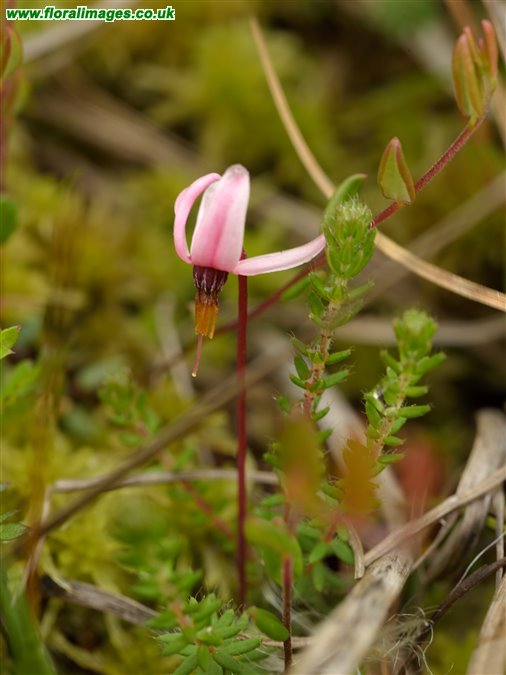
Cranberry or Llygaeren, Vaccinium oxycoccos in a flush near the Carex

The beginning of July saw a group of us undertake a couple of days botanising in the remote north-west of the county, staying at the hostel at Dolgoch. It was a very wet weekend but we were delighted to encounter a field high up under Craig Carreg-fan with abundant Viola lutea.

Mountain Pansy or Trilliw y mynydd, Viola lutea

We climbed up higher and this view back just shows (centre lowdown) the zigzag path through bracken by which we approached the rocks above.

The group excursion outside the county this year took us to Cors Fochno just inland at Borth to see the Irish Ladies Tresses that now have settled there. It was agreat day and we enjoyed the other bog plants as well.

Irish Lady's-tresses or Troellig Wyddelig, Spiranthes romanzoffiana at Cors Fochno

A few other highlights:

Lunch time at the edge of the Epynt


Blue Fleabane or Amrhydlwyd glas, Erigeron acris (Erigeron acer) on Gilwern Hill 
(Picture Anne Griffiths)

Yellow Bird's-nest or Cytwf, Hypopitys monotropa (Monotropa hypopitys) at Cwm Clydach
(Picture Anne Griffiths)