Pages

Friday, September 25, 2015

Marsh Fritillaries

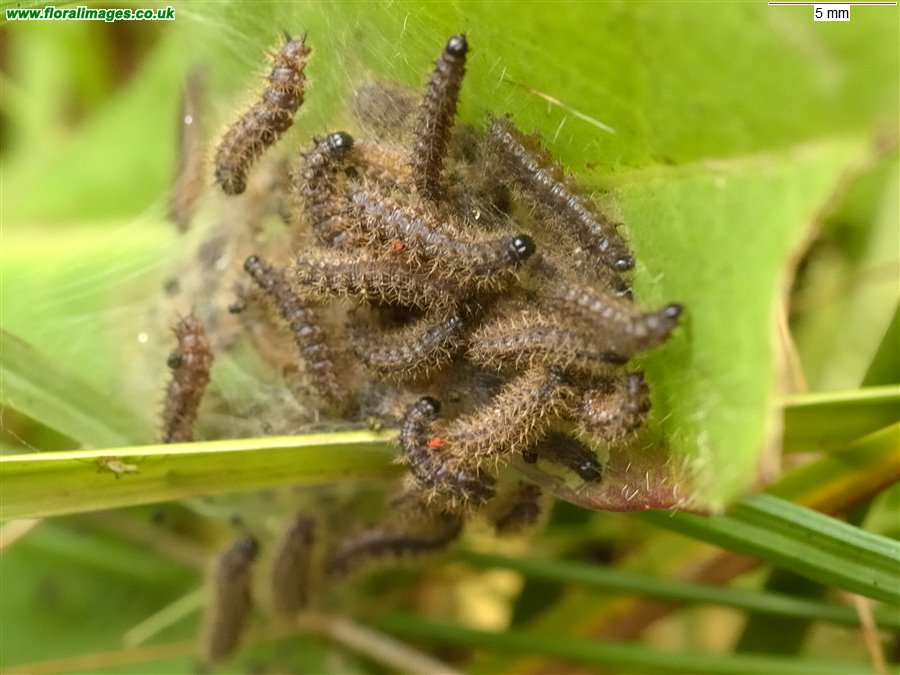
Marsh Fritillary, Euphydryas aurinia

I joined other Trust members on Tuesday for Marsh Fritillary habitat and larval web monitoring at Vicarage Meadows. This threatened species had been seen for the first time in ages there during a botanical outing earlier in the year - indeed the area was thought to be too remote from other populations to support the butterfly.

The search was on for the caterpillars feeding on their staple: Devil's-bit Scabious leaves. There is plenty of that species at Vicarage meadows so it took a lot of looking and, as it turned out, the expert with us, Russel of Butterfly Conservation, Wales was the only person to find any - but the rest of us enjoyed searching!

Marsh Fritillary or Euphydryas aurinia Caterpillars on Devil's-bit Scabious leaves.

Devil's-bit Scabious, Tamaid y cythraul or Succisa pratensis

The search

We also saw:
Saw-wort, Dant y pysgodyn or Serratula tinctoria

This plant was actually in the National nature Reserve beyond Vicarage Meadows but does occur at Vicarage Meadows as well.


Friday, September 18, 2015

Two weeks out and about

I've been out on my own the last two weeks. It probably means a lower species count than when I have company but rewarding nonetheless.

Last week it was a check of a (onetime) Road Verge Nature Reserve with query Bifid Hemp-nettle, Galeopsis bifida.

It was delight to walk along and record. (Do go and see - the Brecon end of the Taff Trail where it goes onto a public road. I was passed by two cyclists, the post van and two cars in the whole 3 or 4 hours I spent there - no walkers at all !)

Just one example:
Betony, Cribau San Ffraid or Betonica officinalis

The Galeopsis was all the more common species (there was a lot):
Common Hemp-nettle, Y benboeth or Galeopsis tetrahit

But we do get the other relative mentioned above in Brecknock. There is plenty of this plant around flowering at the moment - if the DARK markings extend to the edges of the lower petal let me know!

Then on Wednesday I went to a randomly selected square on the map near Cilmery for an initial look at the plants growing there. There was plenty and some varied habitat with a common to wander around at will and plenty of species rich road and lane verges. We will be back next year to complete this survey.
Comin Cefn-poeth from the top of the land.

I love these old Silver-birch trunks with knobbly bark and lichen. There was plenty of both Downy and Silver birch here.

There was an intriguingly marked "Sulphur Spring" on the map - which I take to be this pool full of Broad-leaved Pondweed. It was surrounded by an abundant Sedge I am still pondering over (only one very dead inflorescence and it looks like C. riparia or maybe a hybrid) as well as Yellow Flag Iris and other pond edge plants.
I fancied I got a vague sulphur smell at times but maybe my reading of the map is wrong - it's often hard to know exactly where a map a label this this is referring to...

Broad-leaved Pondweed, Dyfrllys llydanddail or Potamogeton natans

The common was not overgrazed by very sturdy healthy looking sheep leaving plenty to record including abundant Cross-leaved Heath. The sheep must prefer Ling as that was only to be found lurking in the Gorse.
Cross-leaved Heath, Grug croesddail or Erica tetralix

Friday, September 04, 2015

Cwm Oergwm

The Brecon Beacons summits form a long ridge with steep valleys to the northeast, interspersed with long parallel spurs and four round-headed valleys or cwms; from west to east these are Cwm Sere, Cwm Cynwyn, Cwm Oergwm and Cwm Cwareli.

Cwm Oergwm (Valley of the cold valley) was our object last week but we had to cross the stream from Cwm Cwareli to get there. This seemed a trivial matter when we did the recce in March. But August proved much wetter (particularly the night before our outing) and when we got to the ford it didn't look straightforward to cross at all so some time was spent fruitlessly looking for a better crossing point (and finding some new species to record naturally). So, in the end we returned to the normal fording place and took our boots off to cross carefully by wading.

We then made our way up the valley to the upper reaches of the Nant Menasgin, our main recording area, and previously a place where Bog Orchid has been found.
 Picture by Sue

We spent time down by the stream  as well as above it.

After some recording in the main area we had lunch by the stream
... and watched the bubbles in the water at the base of a cascade:

We explored many varied and species rich flushes near the stream but didn't find any Bog Orchid. Plenty of updated records for the 2020 BSBI Atlas were made though. (We found plenty of Sundew, Butterwort, Skullcap and a host of Rushes and Sedges.)

Heather, Grug or Calluna vulgaris

One flush seemed calcareous and had different species including this (mainly well past it like the example on the left) which had us stumped for awhile...
Marsh Arrowgrass, Saethbennig y gors or Triglochin palustris (Triglochin palustre in older books)

Sue and Meg among the heather.

It was much easier crossing back over the Cwareli stream going back as the water had already abated.

Anthony was the only one properly equipped for the ford as we found it.

The Bog orchid hunt isn't over yet - we didn't get to the very highest parts of the stream near the source and further exploration there next year is planned.

As always I owe thanks to my intrepid co-explorers who supplied knowledge, good company and six extra eyes!

Tuesday, August 25, 2015

August

This is a catch up - we have been busy!

A while back several of us gathered in the Grwyne Fechan Valley for unfinished business from last year. Mike and Chris would do the lane near the car and three of us set up along McNamara's Road to explore the upper valley.
Passing a Beet field with plenty of arable weed species
 Crossing the Grwyne Fechan at Tal y Maes Bridge 
We completed the exploration of the target squares started by myself last year and established that one of my imagined species from last year probably wasn't there after all...

My camera didn't come out of the bag so the pictures above are thanks to Sue. We got back to the cars all at roughly the same time, Mike had found many different Brambles amongst a long list and our circular tour had given us plenty to record.

Then two of us went back to restricted areas to complete the National Plant Monitoring Scheme work and look at a field for the landowners.

I don't like trying to identify Burdocks so this went into my records as uncertain:
Wood Burdock, Cyngaf bach or Arctium nemorosum; or is it?

We found substantial numbers of this again:
Mountain Pansy, Trilliw y mynydd or Viola lutea

It doesn't make the Brecknock Rare Plant Register - based on records made in the 1980s but it looks like it will stay off it going forward from recent results - good news.

Heather, Grug or Calluna vulgaris
- flourishing where all but the most adventurous sheep have been kept out.

And here is a Harebell - photographed solely because it was a photogenic specimen...
Harebell, Clychau’r eos or Campanula rotundifolia

Most recently I actually got physical at Allt Rhongyr BWT Nature Reserve, helping (a little) with Bracken slashing, and then went around the reserve finding Autumn Gentian Sites and taking these photographs which I think illustrate what a great reserve it is.

Autumn Gentian, Felwort, Crwynllys yr hydref or Gentianella amarella (picture taken in 2013)

Stop Press: these just in from Sue who was there last Saturday.


Sunday, July 26, 2015

More of the same

We continued our survey of the land near Allt Rhongyr last week.

Picture by Steph who was Bracken-rolling on the reserve

The additions to our list from the week before were relatively few - but significant. Also we established that some species we saw the week before in small quantity were, in fact abundant. Examples follow:

Small Scabious, Clafrllys bach or Scabiosa columbaria (here proliferating a bit from the inflorescence)

Common Rock-rose, Cor-rosyn cyffredin or Helianthemum nummularium

Wall-rue, Duegredynen y muriau or Asplenium ruta-muraria

And this wasn't abundant but definitely present in fern-rich scree:
Green Spleenwort, Duegredynen werdd or Asplenium viride

Tuesday, July 21, 2015

Near Allt Rhongyr

But not in the reserve. We set out up a species rich lane to record in some privately owned land nearby (and therefore recorded the lane as well for general reasons).

It was nice to find a really good stand of Brittle Bladder-fern near one of the many cave entrances in this area:

Brittle Bladder-fern, Ffiolredynen frau or Cystopteris fragilis

Mike showed us a particularly attractive Blackberry - one of the many species he has recorded and helped to identify in our area:
Rubus vestitus (as the only online resource I could find that even attempted a common name calls it: "A Bramble")

When  we got up to the limestone-influenced level we started to find many more choice plants  - including another rarity from a difficult genus:
Hieracium repandulare, Repand-leaved Hawkweed

"A Welsh endemic locally frequent in the Craig y Rhiwarth area and at Craig Cerrig Gleisiad." (BSBI Atlas of British and Irish Hawkweeds). A pity we were too late for the flower...


John and Mike approach a cave entrance (picture by Sue)